
The American Revolutionary War officially ended in Paris by treaty because the war ended at Yorktown by siege. The American forces were aided by the French on land and sea and the siege was largely under the direction of French engineers. The British were significantly outnumbered, trapped on a Virginia peninsula, and without resupply or escape. The circumstances were advantageous for an American victory.
The cast of characters at Yorktown is rich in historical significance. George Washington was the commanding officer, and he even fired the first cannon shot once the siege operations had started. Marquis de Lafayette served with honor. Alexander Hamilton was there and seeking glory of his own. Henry Knox added his experienced leadership. The British were led by Charles Cornwallis who was joined by the ruthless Banastre Tarleton.
The first shots fired at Lexington were the start of the American Revolutionary War. The Battles of Saratoga were the turning point. The Siege of Yorktown was the grand finale. The long war was finally over. The colonialists, the rebels, the backwoodsmen, the Americans, had shockingly defeated the mighty British empire.
Trapped on a Peninsula
Cornwallis led the British southern campaign. His army fought through North Carolina and into southern Virginia in 1781. Cornwallis sought rest for his army in an unusual place. Yorktown, Virginia, sits elevated on the banks of the York River on a little peninsula of marshes and poor roads. Waiting for the navy is about the only thing Yorktown was good for. Otherwise, it was a dead end.
The British navy was considered the best in the world. Colonial America couldn’t compete with such a claim, but the French could. Our ambassadors in France had been lobbying for French assistance, mostly in the form of naval support, since the war began. Their persistence and American victories paid off tremendously by autumn 1781. The French navy was in Chesapeake Bay in time to cut-off Cornwallis from escaping and prevent Henry Clinton from sending help from New York. Cornwallis was stuck in a dead end for sure. It was only a matter of time.
The combined American force of Continentals and militia along with French troops that surrounded Yorktown totaled about 16,000. They were in good condition and primed for a fight. There were also approximately 20,000 sailors on the French fleet nearby. The British army stood at about 8,000 and in poor condition. They had a long trek to Yorktown from North Carolina, were low on provisions, and looking to board ships in retreat.
When the two sides met at Yorktown the atmosphere in the opposing camps couldn’t have been more different. The Americans and French were ready to fight while the British were ready to run. Without outside assistance, Cornwallis’s defeat was enviable. And that assistance from British forces in strong positions in New York never came.
Washington and his officers had two plausible options. They could end it overnight with an overwhelming assault that would leave a lot of their own dead. With a two-to-one advantage they could afford the losses, but that’s a rather inhumane way to win. The second, and more honorable option, was a siege.
Sappers and Miners
Siege warfare is won by the sappers and miners who dig the trenches and parallels which allow the artillery to level their targets with great cover.
Dr. Paul Walker writes, “Three companies of Sappers and Miners totaling 50 men, commanded by William Gilliland, David Bushnell and Daivd Krikpatrick, provided crucial support to the siege. Fifty Delaware recruits supported them.” The French were the more experienced in laying siege and their efficiency should be commended.1
After the engineers had marked their lines, the digging could begin. “Fifteen hundred workers with tools and trenching materials were assembled with 2,800 men under arms to be stationed nearby to protect them from a British sortie,” writes James Haskett. “The soil was soft and sandy, the night dark with a gentle rain.”2
Then the artillery could come into place. The Americans were certainly glad to have had the French with them this time. Nathaniel Philbrick writes in In the Hurricane’s Eye, “The French were recognized as the greatest artillerists in the world: not only was the quality of their weaponry first-rate, but their officers and men were superbly trained. The Americans, on the other hand, had to rely on an inferior hodgepodge of artillery pieces.”
Washington Irving, in his epic biography George Washington, describes the selflessness of patriotic America. “[Thomas] Nelson, who had so nobly pledged his own property to raise funds for the public service, gave another proof of his self-sacrificing patriotism on this occasion. He was asked which part of the town could be most effectively cannonaded. He pointed to a large handsome house on a rising ground as the probable headquarters of the enemy. It proved to be his own.” Our Founding Fathers really did pledge their lives, their fortunes, and their sacred honor in their fight for independence.
The bombardment lasted only a few days. Cornwallis surrendered. On October 19, 1781, the most part, the war ended.
Impact
The war didn’t actually end for another two years when the Treaty of Paris was signed, but Yorktown was the last major engagement of the war. The significance of the defeat was not lost on leaders back in Britian. Lord North cried out, “Oh God, it is all over!” He was right.
Cornwallis returned to England a defeated general but avoided the brunt of the blame. “Sir Henry Clinton received most of the blame for Yorktown from all quarters of the press,” writes Solomon Lutnick. “He not only had allowed Washington to march past him through the Jersies, he had refused to reinforce Cornwallis; and the latter, the press believed, was now justified in criticizing his superior officer.” That is fair criticism. Washington’s army had a long trek to get to Yorktown, and they marched there unmolested by any large force from Clinton. An enemy having free passage to a major theater is a failure. Clinton deserves blame for that.3
The criticism on Clinton for failing to rescue Cornwallis isn’t all that fair. Cornwallis picked a terrible place to set up. The British knew this having seen it early that same year with forces commanded by the traitorous Benedict Arnold. They learned nothing. Add that to the French fleet guarding the entrance to Chesapeake Bay, and there’s little the British navy in New York could’ve done.
Cornwallis alone deserves blame for the botched surrendering ceremony that took place. Commander-in-Chief George Washington was there to accept Cornwallis’s sword, but Cornwallis claimed to be sick and couldn’t attend. Yeah, right. What a chump. The Brit’s number two didn’t know who to give his sword to. A needless mess, but the Americans had their victory and that’s all that matters.
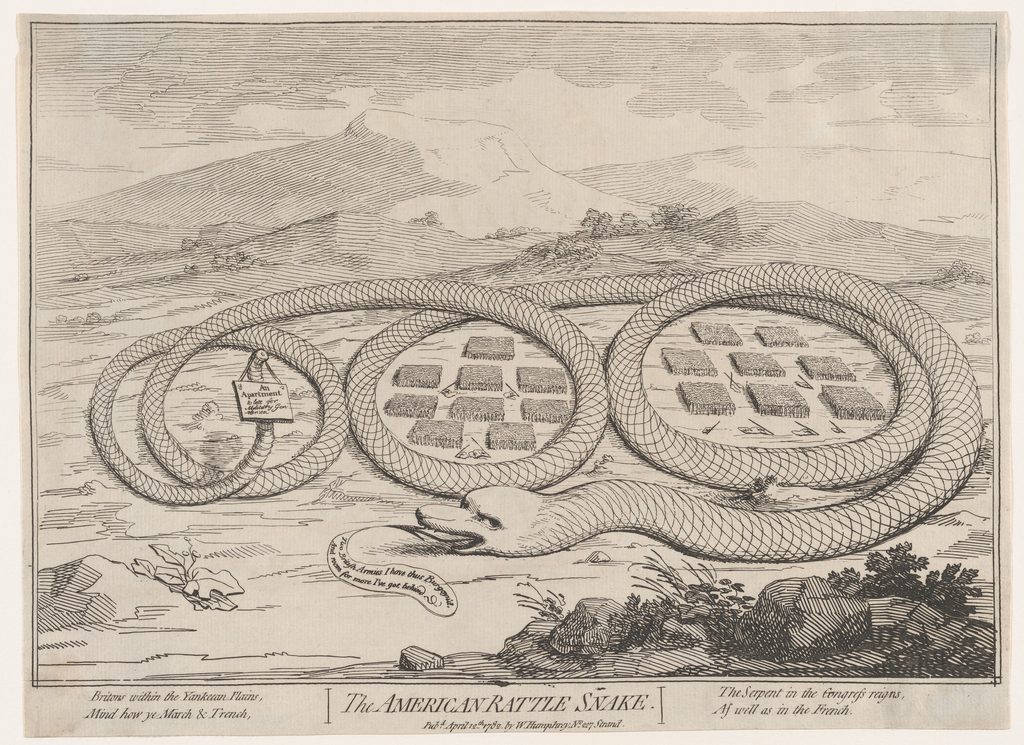
A few months after the surrender at Yorktown, James Gillray made a satirical print that circulated in London. Titled “The American Rattle Snake,” it depicts a giant snake wrapped around two different armies, which symbolize John Buurgoyne’s surrender at Saratoga, and Cornwallis’s surrender at Yorktown. The serpent’s tongue holds a message that reads, “Two British Armies I have thus Burgoyn’d, And room for more I’ve got behind.” The Brits knew it was over.
Let the Band Play You Out
“The World Turned Upside Down” is the reported tune that the British band played as their army marched under terms of surrender. The British couldn’t believe they lost. The Americans were merely uncivilized colonialists to many Brits. Tough for them to appreciate how backwoodsmen could defeat the most trained and best equipped army and navy in the world. The song meant that bad things were happening and more bad things were to come, so the Brits may have meant it as an insult and took it themselves as a sad song. Ok, that’s fine.
It’s fine because Americans can take it and spike the football. “The World Turned Upside Down” is apt and Americans should celebrate it. The American Revolutionary War didn’t just create a new country; it broke the mold and forged a new order for civilization. Self-government was a great experiment yet to be tried in a republic the size of the United States. We’ve proved we can do it, but in 1781 there was a lot of uncertainty to compete against. Taking the song as triumphant with a ‘heck yeah’ and ‘there’s more to come’ may be the best way to jam with the losing band here.
Naval historian Tim McGraw makes an important note on this in his book Give Me a Fast Ship. “It is interesting to note that it was also the melody to the song ‘When the King Enjoys His Own Again.’ As the war had more than a year remaining, perhaps it was that song’s lyrics running through the Redcoats’ heads.” The Brits who would not accept defeat could have been humming along to that one as they waited for a comeback that would never happen.
***
The Siege of Yorktown ended with the surrender of Cornwallis’s army which effectively ended the American Revolutionary War. Although two years were to pass before a formal treaty was signed, the long war was over. The Americans had won and George Washington won on his home soil. Peace would eventually takeover and although it took a century, a special relationship would seal a lasting bond between the United States of America and England.
Notes
1. Walker, Paul K. “An Engineering Victory: The Siege of Yorktown, 1781.” The Military Engineer, vol. 73, no. 475, 1981, pp. 334–37. JSTOR, http://www.jstor.org/stable/44558823
2. Haskett, James N. “Military Engineers at Yorktown, 1781.” The Military Engineer, vol. 68, no. 443, 1976, pp. 175–158. JSTOR, http://www.jstor.org/stable/44607208
3. Lutnick, Solomon M. “The Defeat at Yorktown: A View from the British Press.” The Virginia Magazine of History and Biography, vol. 72, no. 4, 1964, pp. 471–78. JSTOR, http://www.jstor.org/stable/4247059
Photo credit
Gillray, James. “The American Rattle Snake.” The Met