
The name popularly known is the Battle of Saratoga, which sounds like one fight. That is misleading. Two large-scale battles over the course of three weeks south of Saratoga, New York became summarized as the Battle of Saratoga. A summary and a nearby location are not uncommon ways to name battles of a more complex nature. The popular name doesn’t miss entirely, but preference should be given to the Battles of Saratoga as the more appropriate name for what became the turning point of the American Revolutionary War.
A British army under the command of General John Burgoyne were marching their way south to Albany. After passing Saratoga they became engaged by a waiting force of Continentals and militia under the command of Major General Horatio Gates. The first fight was the Battle of Freeman’s Farm on September 19, 1777. The second was the Battle of Bemis Heights on October 7. The Americans forced the British to retreat north to Saratoga where, on October 17, General Burgoyne surrendered his army to General Gates. The consequences were felt globally.
Battle of Freeman’s Farm
South of Saratoga laid loyalist to the crown John Freeman’s farm. Further south stood a hill known as Bemis Heights, where Gates and his army waited. When the British were spotted forging in the farmland, a fight ensued. The first action was led by Colonel Daniel Morgan and his Virginia Riflemen.
Fighting was intense, but the engagement was never meant to be a large battle. Gates was on a defensive strategy as he enjoyed the high ground at Bemis Heights, while Burgoyne was weak, low on provisions, and running out of time. There was no need to risk American lives, especially when, overall, the recruitment needs of the Continental Army and state militia’s were still wanting. But the army outside of Saratoga was not diminished, it was actually growing. Militiamen from New York were coming into camp having heard of the British march to Albany. New York’s backwoodsmen were not going to let the Brits walk to Albany without a fight.
Burgoyne’s army was low on provisions thanks to his distance from supply centers, the duration of the campaign, and from direct action by New Hampshire militia. The British sent out a party of mostly Hessians to raid an arms and foodstuffs cache in Bennington. The Hessians were routed by a force under the command of John Starks, a firebrand leader who led his own unit, and answered to few, if any. Failing to secure those addition provisions in the Battle of Bennington became a key factor in the deteriorating condition of Burgoyne’s army.
The Battle of Freeman’s Farm was a victory for the Americans, but not a decisive defeat for the British. General Burgoyne had pulled back enough and General Gates did so too. Both armies had engaged each other like heavyweights in the early rounds of a title fight; they felt each other out, threw a few big punches, but saved their knockout material for later. And that later would come in about three weeks.
Battle of Bemis Heights
The second of the Battles of Saratoga took place just south of Freeman’s Farm near a hill now known as Bemis Heights, which overlooked the farmland to its north and the Hudson River to its east. General Gates had set up his headquarters there and his army was well dug in. Any approach would have to be from an overwhelming force if there was any chance to dislodge the waiting Americans. The British knew their dwindled army wasn’t overwhelming, but they had little choice otherwise than to attack. Starvation doesn’t have the same honor as fallen on the battlefield.
Legendary author Washington Irving describes the important win as; “The victory of the Americans was decisive. They had routed the enemy, killed and wounded a great number, made many prisoners, taken their field-artillery and gained possession of a part of their works…”
There was nothing left for Burgoyne to do but retreat north with his remaining men to Saratoga. There the British regrouped, inspected their dwindling provisions, and could only conclude that asking for a treaty with Gates was the only way to save the lives of those left.
On October 17, terms were agreed to and General Burgoyne surrendered to General Gates. The British gave up their arms and artillery, but officers could keep their sidearms. The British kept their colors and were to return to England, never to rejoin the army to fight in this ongoing revolution.
Burgoyne faced ridicule at home. He was initially blamed for the crushing defeat and would have to defend himself in front of Parliament before a House united against him. Historians have lighten the load from his responsibility. The Americans had a greater force, which grew, had a seasoned group of officers, fought on their home turf, and General Burgoyne couldn’t supply his army, couldn’t increase its size, and couldn’t do much in the wilderness of central New York. The surrender at Saratoga wasn’t so much anyone’s fault thanks to it being a success from key figures and beneficial circumstances.
The Significance
The American victories at Saratoga can hardly be overstated. It was the turning point of the American Revolutionary War for several reasons.
First and foremost, the victories convinced the French to commit serious military forces to our aid. Our army desperately needed a well-equipped navy. The French had such a naval force, and its addition was instrumental to our victory in the overall war.
The French were more enticed to join our side because the Continentals and militia beat an army led by General John Burgoyne. The French had faced and lost to Burgoyne in the Seven Years War. Many considered Burgoyne to be the best general the British had in North America. If a ragtag group of colonists could beat an established army with a respected commander, then maybe the Americans weren’t just a ragtag group of colonists after all.
The victories stopped the British from executing a potentially crippling strategy against the thirteen united states. The Hudson River split New York and created a barrier between New England and the rest of the states. Had the British taken total control of the Hudson, then they would have split the Americans in two. Communications, supplies, and troops would hardly have any chance of moving between the two divided regions. The spilt would have likely destroyed the rebellion and kept those newly declared independent states as British colonies.
The victories also gave more credibility to the militias fighting in their own backyards throughout the states. The Continentals were there, too. But the New York and New Hampshire Militias played key roles. The militia were unfairly viewed by the British (and the French) as unprofessional and inadequate against a force as mighty as the British. No uniforms, hardly any training, their own gun, their own boots, the militia represented many opposites from their uniformed, highly trained, well-supplied opponents. Militias everywhere in America would gain the credit they deserved. Saratoga was one of the early places where American militia stood tall and proved to the world that we could win the war.
And let’s not forget the significance of the location. In addition to the strategic geographic location mentioned above, New York was home to the largest group of loyalist to the crown that were still hanging around in North America. A large British army with a well-known British General in the friendliest state to the British made for a favorable arena but turned out to be the place where the British faced their most crushing defeat thus far of the war. That was improbable to the point that it created terror in some Brits back in England. Not even in Loyalist New York were the British safe.
Key Figures
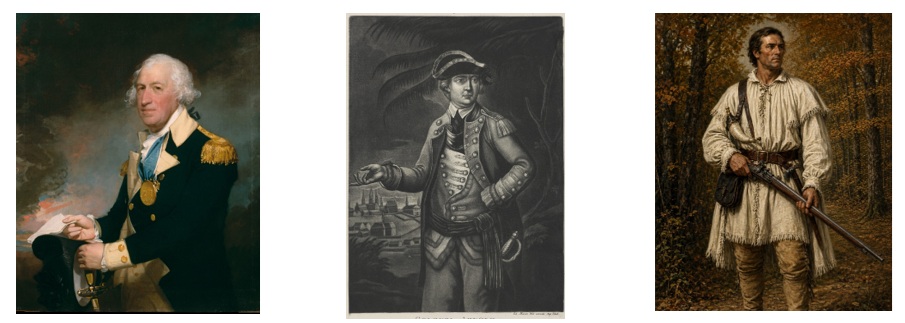
Major General Horatio Gates
The man credited the most for victory at Saratoga is Major General Horatio Gates. He was the commanding officer and he crafted and stayed to his plan of waiting for the British. General Gates had strength and he knew it. General Burgoyne’s army was weak and ill-supplied, and Gates knew that too. The advantages were evident and Gates was wise enough to play a strong hand with caution.
General Gates certainly deserves praise for Saratoga, but he wasn’t on the battlefield. He hadn’t mounted his horse, drawn his sword and commanded troops in action. Those images of action were still reversed for General George Washington and Major General Benedict Arnold. Gates won the Battles of Saratoga from his tent, which is not uncommon for generals. He was an administrator, a delegator, a commander of logistics and protocols. He wasn’t Washington. Nevertheless, General Gates was the winner, and those battles led to the French alliance, and we wouldn’t have won the war without French assistance.
The big win at Saratoga for General Gates elevated his status throughout the country and the Continental Congress. It had been nearly an entire year since George Washington’s big wins at Trenton and Princeton. Since then, he had little success to show. Historian Joseph Ellis writes in His Excellency, “The stupendous success at Saratoga cast Gates’s star in ascendance and invited behind-the-scenes comparisons with Washington’s failure to prevent Howe’s capture of the American capital city [Philadelphia].” Ellis continues, “The truth was that Saratoga unleashed a whispering campaign against Washington that had been simmering beneath the surface ever since the debacle at Fort Washington. The larger truth was that criticism of Washington could only take the form of whispers, since his transcendent status as ‘His Excellency’ levitated above all political squabbles, making direct criticism almost sacrilegious.”
Washington would endure the whisper campaign, stay as commander-in-chief, and fire the first cannon shot at the Siege of Yorktown. Gates would find disgrace in a bad loss in Camden, South Carolina in 1780. His reputation never recovered.
Major General Benedict Arnold
Not yet the traitor he has become immortalized as, Major General Benedict Arnold served with distinction at Saratoga.
During the Battle of Freeman’s Farm Arnold was stuck at camp due to orders from Gates. Arnold’s exact role is disputed. The official account, written by officers who did not like Arnold, does not mention Arnold. This became a great problem for Arnold, who demanded the credit he felt he deserved. Arnold did direct troops movements from his headquarters based on intelligence he received from the field. He even tried to ride to the battlefield, but was quickly recalled by Gates. He certainly deserves some credit at the very least, but Arnold felt robbed and that led to a confrontation between the two generals which resulted in Arnold losing any responsibility in Gates’ army. A higher-ranking general was now in camp, so Gates had felt he had no more use of Arnold.
“Arnold and Gates were two very different men, and part of the reason they had worked so well together the previous year was that they had been separated by the length of Lake Champlain,” writes Nathaniel Philbrick in Valiant Ambition. “Arnold was too emotionally obtuse, too aggressive and impulsive to work closely with a commander whose greatest strength were administrative and who had never commanded an army in battle.”
When the Battle of Bemis Heights began, General Arnold found himself away from the battlefield, but this time with no one to command. He raged about for a little before mounting his horse and riding into battle without authorization. An officer tried to stop him, but this time Arnold would not yield. The accounts seem to vary from heroic to suicidal in describing Arnold’s actions that day. Apparently, through the chaos of battle Arnold was able to identify and then order men to exploit a vulnerability. Soldiers in the heat of action have no time and little concern for military politics. The fact that General Arnold held no responsibility meant nothing to American soldiers during the fight. They followed superior officer and a warrior who was hellbent on winning.
Arnold’s end is the most disappointing of any American officer who served in the Revolutionary War. He tried and failed to surrender West Point to the British, fled to the safety of the enemy, and stayed in the war on the British side as a general who led campaigns against Americans. Today, Benedict Arnold means traitor and everyone understands that. He died after the war in England in disgrace.
Colonel Daniel Morgan’s Virginia Riflemen
Colonel Daniel Morgan led a light infantry unit of riflemen in the Battles of Saratoga. His unit was made up mostly of Virginians. Their rifles offered a more accurate shot from a greater distance than the more common muskets used by the Continentals and militia. Experienced officers are an asset in battle. Morgan’s riflemen were able to point out the British officers and then put them down, creating confusion and even chaos among the enemy. Nearly every account of the Battles of Saratoga mentions the killing of British General Simon Fraser as an important turning point. Fraser was shot by one of Morgan’s riflemen.
Morgan’s riflemen began to personify what would become a lasting image of the American backwoodsman. Instead of an official army uniform, Colonel Morgan’s riflemen wore their homespun hunting gear. Leather, deerskin, coonskin, animal-whatever-skin, like Daniel Boone. Morgan even used a turkey call as a rally cry in battle. To the British, that ragtag group must’ve been frustrating as their results were hard to deny. The rifle’s accuracy, the strange dress, and rugged lifestyle all added to the tales of incredible marksmanship.
When scouts returned to General Gates with intelligence that the British were positioned for a fight, it was Colonel Morgan who was given the first order to engage the enemy. Morgan was a leader in the lead at Saratoga. The efforts of Colonel Morgan and his riflemen deserve fair mention with the accolades for Generals Gates and Arnold.
Photo credits:
Horatio Gates by Gilbert Sturat, The Met
Colonel Arnold by Johann Martin Will, The Met