
The first report on the University of Virginia by its Board of Commissioners was agreed to and signed on this day in 1818. Founded by Thomas Jefferson, who is among the signers of the first report, UVA has grown into a nationally respected institution.
The first item the Board discussed was the location. They considered three places: Lexington, Staunton and central college in Albemarle County (Charlottesville). Keeping in mind that West Virginia was still Virginia, the Board concluded, “It was the degree of centrality to the white population of the state which alone then constituted the important point of comparison between these places: and the board, after full enquiry & impartial & mature consideration, are of opinion that the central point of the white population of the state is nearer to the central college, than to either Lexington or Staunton by great & important differences.”
Oh my, but it makes sense. Central in population and population alone would’ve been enough. If leftists read that is why UVA is located in Charlottesville, then they may feel the need to leave behind a beautiful campus, I meant grounds, for the urban decay of Richmond. That would be a mistake. Charlottesville is nice and the lawn on grounds is as beautiful as it is obnoxious to say.
The next order of business was to agree to the layout of the buildings. It is here in the board’s description where UVA first received its cherished monikers of “lawn” and “grounds.” Don’t say campus at UVA, but don’t worry if you do because anyone and everyone there stands primed to correct you.
Then the report goes into courses and professorships, but before it goes into all of that, it offers the objects, or goals, of the university. The list is 12-points in all, and they emphasize empowering individual liberty. The first object is, “To give to every citizen the information he needs for the transaction of his own business.” Another lengthier point is, “To expound the principles & structure of government, the laws which regulate the intercourse of nations, those formed municipally for our own government, and a sound spirit of legislation, which banishing all arbitrary & unnecessary restraint on individual action shall leave us free to do whatever does not violate the equal rights of another.” That last point may offer too much tolerance for today’s faculty at UVA.
The courses described are to be expected. Below is a picture of the courses listed, taken from Founders Online, a great site for original documents from our Founding Fathers.
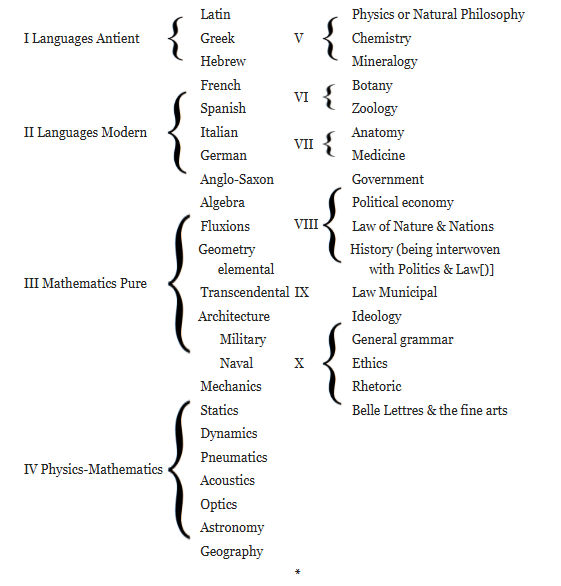
The * at the end of the list receives the following note, “Some of the terms used in this table being subject to a difference of acceptation, it is proper to define the meaning and comprehension intended to be given them here.” But for the most part, the terms are fairly known and offer little confusion. There are only a few examples which may need further explanation.
In Section III Mathematics Pure there is a course called Transcendental, which, may need some detail, or at least it did for this author. The description follows the one for Geometry, which reads, “Geometry elemental is that of straight lines and of the circle.” And then, “Transcendental, is that of all other curves.” Chemistry has a definition that is narrow in its application; “Chemistry, is meant, with its other usual branches, to comprehend the theory of Agriculture.” And as Jefferson was a great admirer of Isaac Newton, there is a course on “Optics the Laws of Light & vision.”
In January of 1800, Thomas Jefferson wrote, “We wish to establish in the upper & healthier country, & more centrally for the state, an University on a plan so board & liberal & modern, as to be worth patronizing with the public support, and be a temptation to the youth of other states to come and drink of the cup of knowledge & fraternize with us.” Jefferson’s wish came true when UVA opened its doors in 1819.