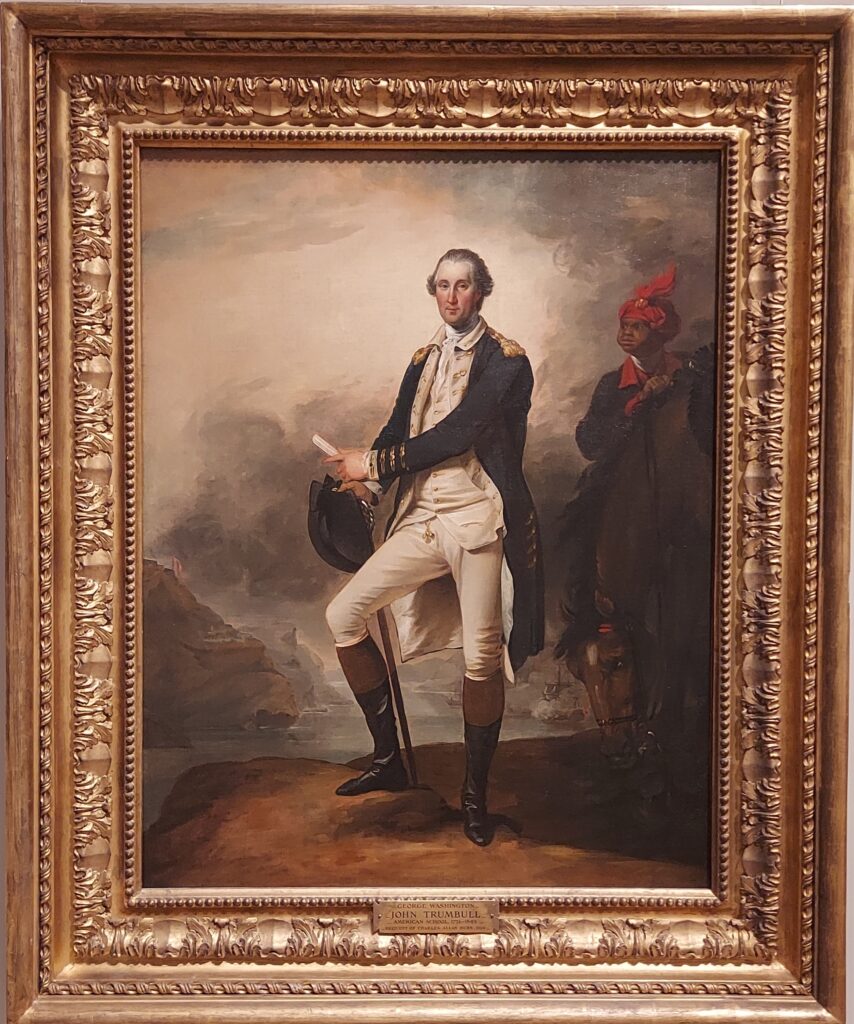
George Washington and William Lee by John Trumbull is a classic American portrait of one of our Founding Fathers. The painting was originally and more simply called George Washington, but an abundance of works and the fact that he’s not alone in this piece gave way to the popular title known today.
Hanging in the Metropolitain Museum of Art in New York City, the description reads-
“In this famous painting by Trumbull, Washington is depicted standing above the Hudson River with a Black figure assumed to be William Lee- his enslaved valet, groom and military aide. Trumbull had served on Washington’s staff early in the Revolutionary War. He painted this from memory years later while studying in London. It was the first authoritative portrayal of Washington available in Europe and was soon widely copied.”
The face and military uniform are considered accurate and tribute to the artist’s incredible skill. The way the jacket hangs on Washington’s shoulders, his scarf, and the creases in his shirt are wonderfully detailed. When taken into account that Trumbull did this on memory, then the work becomes all the more impressive.
The one inaccuracy of the painting is found in Washington’s companion William Lee, known as Billy. Trumbull chose to portray Billy Lee in a turban, which Lee certainly never wore. The Met’s description further reads-
“Trumbull would have known Lee, yet chose to depict him in a turban, based on European Orientalist convention associated with Black figures. An accurate portrait of Lee- whom Washington freed and granted an annuity in his will- is unknown.”
Artists often take liberty to add or delete details to make their work more palatable to the viewing public. Clearly, Trumbull took the liberty to portray Lee in a more familiar appearance to the European audience who would first see this masterpiece.
Historian Joseph Ellis, in a biography on Washington titled His Excellency, writes that during the Revolutionary War Lee “accompanied [Washington] on foot and on horseback at all times, brushed his hair and tied it in a queue every morning, but no record of their conversations has survived.” After the war, Lee stayed with Washington, enslaved at Mount Vernon.
Lee’s freedom and annuity were, as Washington wrote in his will, for “faithful services during the Revolutionary War.” We don’t know much about Billy Lee and while Trumbull’s choice of depiction is understandable for his discipline it is nevertheless a little frustrating for historical disciplines.